Minerva Terrace
Alerts
3 more for Yellowstone National Park
About
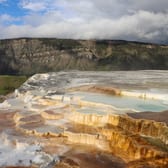
Activity shifts dramatically around this terrace, named for the Roman goddess of artists and sculptors.
The cascades of travertine beside the boardwalks were formed in the 1990s. Some years, they are dry.
In dry areas, you can clearly see the many layers and the varying depths.
Mammoth Hot Springs
A network of fractures and fissures form the plumbing system that allows hot water from underground to reach the surface at Mammoth Hot Springs. Small earthquakes may keep the plumbing open. The water comes from rain and snow falling on surrounding mountains and seeping deep into the earth where it is heated.
The volcanic heat source for Mammoth Hot Springs remains somewhat of a mystery. Scientists have proposed two sources: the large magma chamber underlying the Yellowstone Caldera or a smaller heat source closer to Mammoth.
For hundreds of years, Shoshone and Bannock people collected minerals from the Mammoth Hot Springs terraces for white paint.
Travertine Terraces
Travertine terraces are formed from limestone (calcium carbonate). Water rises through the limestone, carrying high amounts of dissolved calcium carbonate. At the surface, carbon dioxide is released and calcium carbonate is deposited, forming travertine, the chalky white rock of the terraces. Due to the rapid rate of deposition, these features constantly and quickly change.
Color & Heat Lovers
Hydrothermal features are also habitats in which microscopic organisms survive and thrive. They are called thermophiles: "thermo" for heat and "phile" for lover.
Although they are too small to be seen with the naked eye, trillions are grouped together and appear as masses of color. They are nourished by energy and chemical building blocks.
Colorless and yellow thermophiles grow in the hottest water.
Orange, brown, and green thermophiles grow in cooler waters.
Imagine living in near-boiling temperatures, in hydrothermal features with the alkalinity of baking soda, or in water so acidic that it can burn holes in clothing. Microorganisms in Yellowstone need these extremes to survive.
Accessibility
The trail from the Lower to Upper terraces includes steep boardwalks and several hundred stairs. This strenuous trail is not recommended for people with heart, lung, or other health conditions. Consider driving to the Upper Terrace Drive for an alternate view of the area.
Use Caution in Hydrothermal Areas
Stay on boardwalks and designated trails.
Hydrothermal water can severely burn you.
Never run, push, or shove.
Supervise children at all times.
Do not scratch hydrothermal mats.
You are responsible for your safety.
Think safety, act safely. Yellowstone is a dangerous place.
From the National Park Service · nps.gov
Getting there
Directions
At Mammoth Hot Springs - Lower Terraces
2 Officers Row, Yellowstone National Park, WY 82190
Go to Mammoth Hot Springs - Lower Terraces.
Get directionsContact
Links
Nearby
Other places within a few minutes' walk of Minerva Terrace.