
Calcite Springs
Alerts
2 more for Yellowstone National Park
About
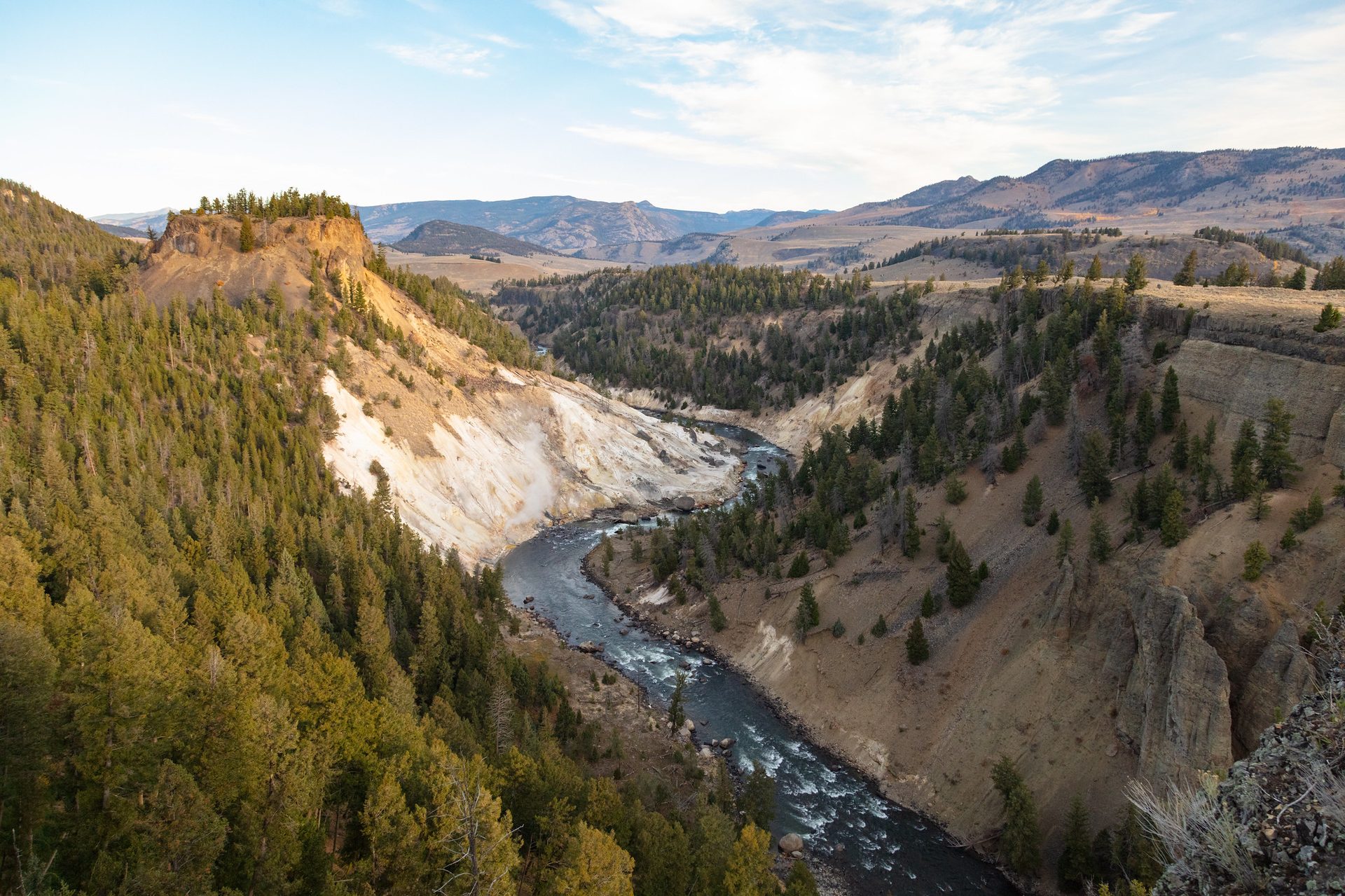
The heat of underground fractures releases deposits of oil from rocks deep below the surface to slowly and sporadically seep to the surface at Calcite Springs.
The springs are hot enough at depth to liquefy large quantities of sulfur that are found here. Occasionally, the molten sulfur oozes the surface where it flows like molasses.
Because contact with air causes the liquid sulfur to turn to black, it is impossible to tell by looking if the dark areas are oil and sulfur.
Calcite Springs was named for the milky-white calcite crystals that cover the area. Mixed in with the calcite are translucent, honey-colored barite crystals. Inside the conduits of hot spring are beautiful but smelly yellow sulfur crystals.
The Calcite Springs hydrothermal area is closed to visitors. To see directly down into Calcite Springs, hike the Yellowstone River Picnic Area Trail. The short, easy trail follows the canyon rim opposite this overlook. To reach the trailhead, turn right (north) at Tower Junction and park at the picnic area 0.5 mile beyond (east of) the bridge.
Hot Springs
Hot springs are the most common hydrothermal features in Yellowstone. Their plumbing has no constrictions.
Superheated water cools as it reaches the surface, sinks, and is replaced by hotter water from below.
This circulation prevents water from reaching the temperature needed to set off an eruption.
Wildlife Watching
Look for bighorn sheep along the Yellowstone River opposite of Calcite Springs.
Animals are Dangerous
Do not approach or feed any animal.
Bison and elk have injured people.
Stay 100 yards (91 m) from bears and wolves.
Stay 25 yards (23 m) from all other animals.
You are responsible for your safety.
Think Safety, Act Safely. Yellowstone is a Dangerous Place.
From the National Park Service · nps.gov
Look inside
Getting there
Directions
2 Officers Row, Yellowstone National Park, WY 82190
Go to Yellowstone National Park.
Get directions