
Kirkland Memorial
Alerts
2 more for Fredericksburg & Spotsylvania National Military Park
About
On the evening on December 13, 1862, as hundreds of US soldiers lay wounded on the fields in front of the Sunken Road, a young Confederate sergeant crossed over the stone wall, and, under cover of darkness distributed water to the wounded enemy soldiers.
The soldier who committed this brave act was reported later by Confederate General Joseph Kershaw to be Richard Kirkland, of the 2nd South Carolina. Kirkland became known as the "Angel of Marye’s Heights" and his story is an oft-repeated one, highlighting the bravery of soldiers, the horrors of war, and the hope that the connections between us are more powerful than things that divide us.
Kirkland did not survive the war; he died at the Battle of Chickamauga on September 20, 1863.
Memory, Myth, and Truth in the Story of Richard Kirkland
Whether the Kirkland story is based in fact or if it exists only in legend has been a question surrounding the story for a long time. What does the evidence tell us?
People did tell stories after the battle of good deeds, like the ones attributed to Kirkland. A few weeks after the battle, Walt Whitman, volunteering in a Union hospital, recorded a wounded US soldier recounting several Confederate good Samaritans who crossed the battle lines to provide aid for the wounded. In 1870, a James Hagood wrote of a soldier in Kershaw’s brigade who went over the wall to assist the Union wounded.
In 1880, newspaper editor Carlyle McKinley prompted Kershaw to identify the good Samaritan in his brigade. Kershaw quickly identified Richard Kirkland and wrote the account of Kirkland’s deeds that became the version of the story most often retold today. After 1880, at least 5 other members of the 2nd South Carolina also named Kirkland as the hero.
There is little reason to doubt Kershaw’s naming of Kirkland, the two were not connected or related in any way. At the same time, Kershaw’s story is filled with dialogue and detail that seem improbable to have been remembered with such exactness over 20 years after the event.
A History of the Memorial
At the time of the Civil War, the parcel of land where the Kirkland Monument now stands was the location of the Ebert House. The Ebert family purchased the land in 1858 and ran a small family store from their home which stood in the shadows of Brompton, perched atop Marye's Heights. By the 1950s the Ebert House had deteriorated and was ultimately demolished in 1957. In the 1960s the land was saved from development by the University of Mary Washington. The University of Mary Washington also owns and maintains the large manor, Brompton, across the Sunken Road as housing for the university president.
The legendary story of Richard Kirkland proved particularly inspiring to Dr. Richard Lanier, a South Carolinian who had a dental practice in Fredericksburg. Dr. Lanier led fundraising efforts, ultimately resulting in significant contributions from the states of Virginia and South Carolina and the creation of the Kirkland Memorial Committee.
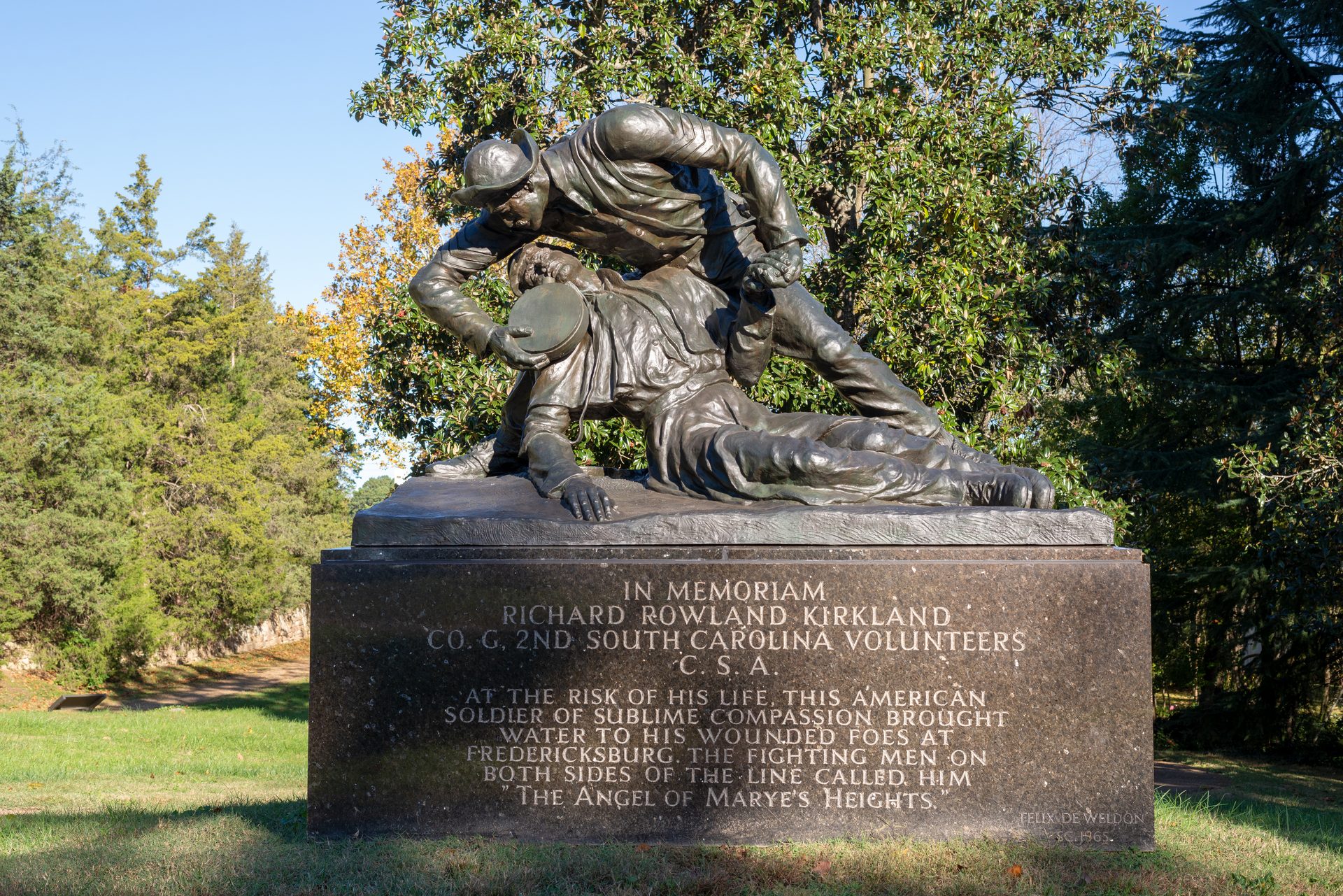
With funds in place, the Committee commissioned sculptor Felix de Weldon (who had completed the famous Iwo Jima Memorial) to design and fabricate the new memorial. The finished statue depicts Kirkland bending over a fallen US soldier, offering the wounded man a canteen in one hand, and holding his hand in the other.
In 1965 the Kirkland Monument was dedicated at its current location. In 1987, the University of Mary Washington transferred the land, and Kirkland Memorial, to the National Park Service.
Description
This life-size bronze statue measuring 5’6” x 8’4” x 4’9” depicts Kirkland bending over the figure of a wounded Union soldier. He supports the head of his recumbent foe on his right knee while giving him water from a canteen. The Confederate symbolically grasps the left hand of the Union soldier as if in brotherhood. The sculpture is situated atop a rectangular base of black marble measuring 3’2” x 9’0” x 5’6” that is engraved with the words:
[South Face]
IN MEMORIAMRICHARD ROWLAND KIRKLAND
CO. G, 2ND SOUTH CAROLINA VOLUNTEERS
C.S.A.
AT THE RISK OF HIS LIFE, THIS AMERICAN
SOLDIER OF SUBLIME COMPASSION BROUGHT
WATER TO HIS WOUNDED FOES AT
FREDERICKSBURG. THE FIGHTING MEN ON
BOTH SIDES OF THE LINE CALLED HIM
“THE ANGEL OF MARYES HEIGHTS.”
FELIX DE WELDON
S.C. 1965
[East Face]
DEDICATED
TO
NATIONAL UNITY
AND THE
BROTHERHOOD OF MAN
[North Face]
KILLED IN ACTION AT CHICKAMAUGA, SEPTEMBER, 1863
BORN, KERSHAW COUNTY, S.C., AUGUST, 1843
SERGEANT AT FREDERICKSBURG, DECEMBER, 1862
LIEUTENANT AT GETTYSBURG, JULY, 1863
[West Face]
ERECTED BY
THE STATE OF SOUTH CAROLINA
THE COMMONWEALTH OF VIRGINIA
COLLATERAL DESCENDENTS OF
RICHARD KIRKLAND AND
CITIZENS OF THE UNITED STATESDR.
RICHARD NUNN LANIER
EXECUTIVE DIRECTOR
OF THE
RICHARD ROWLAND KIRKLAND
MEMORIAL FOUNDATION
1964
From the National Park Service · nps.gov
Look inside
Getting there
Directions
At Fredericksburg & Spotsylvania National Military Park
120 Chatham Ln, Fredericksburg, VA 22405
Go to Fredericksburg & Spotsylvania National Military Park.
Get directionsContact
Links
Nearby
Other places within a few minutes' walk of Kirkland Memorial.
Littlepage Animal HospitalHours not listed © OpenStreetMapMarye's Heights: Artillery Position Downtown Chiropractic and RehabilitationHours not listed