
Mission Tejas State Park
About
Located within the homeland of the Hasinai Caddo, the area now known as Mission Tejas State Park is one of the earliest locations documented by Spanish explorers along the route that would become El Camino Real de los Tejas. After French colonists from Louisiana settled on Texas’ eastern coast in 1685, Captain Alonso de León and Fray Damián Massanet led an expedition from New Spain into the heart of Texas to counter further French colonization. By 1690, the pair made contact with the Caddo, who they referred to as the Tejas. At first, they welcomed the Spaniards’ arrival. As Juan Batista Chapa, a diarist accompanying the expedition, remembered the initial festivities: “After this celebration, the royal standard was raised in the name of His Majesty, and the governor of the Tejas and his captains gave it their obedience. General Alonso de León, in the king's name, promised to favor them and to assist them in every way possible. He gave the Tejas governor a title and nomination with all the formalities and turned over to him a staff as a symbol and ordered all the Indians to respect him and obey him as their governor and captain general.”[1]
While Captain de León continued his march eastward, he left three soldiers among the Tejas along with three priests – Fray Miguel de Fontecuberta, Fray Antonio de Bordoy, and Fray Francisco Casañas de Jesús María – who intended to build a Christian mission.[2] Fray Damián Massanet also remained to serve as “administrator of conversions” at the new mission. On June 1, 1690, the church and dwellings for the priests were completed and that morning the padres “consecrated the church and celebrated mass, after which the Te Deum Laudamus was sung in thanksgiving, the soldiers firing a royal salute.” The mission and village were then dedicated to St. Francis, the mission then taking the saint’s name, Mission San Francisco de los Tejas.[3]
Spanish sources claim that the Tejas initially welcomed conversion. According to the diary of Fray Massanet, the spiritual leader of the village transferred his religious responsibilities to the padres. He declared to the Tejas that “now you will no longer heed me, for these priests who have come to you are the true priests of Ayimat Caddi.” Meaning “The Great Captain,” the Spanish missionaries interpreted this term to refer to their Christian God.[4] Despite this warm reception, however, the mission proved to be short-lived. A smallpox epidemic in the winter of 1690 killed almost 3,300 people in the surrounding area and Spanish soldiers grew increasingly brutal in their treatment of the Tejas. These tensions intensified into vocal resentment, and the Tejas began planning to destroy the mission and expel the missionaries. But before the attack commenced, Fray Massanet learned of the plot and evacuated the mission on October 6, 1693, burning down the original church to cover their escape. Spanish padres launched a second attempt to reestablish a mission among the Tejas in 1716, but elevated tensions between French and Spanish forces left few supplies for the mission, which shuttered permanently in 1719.[5]
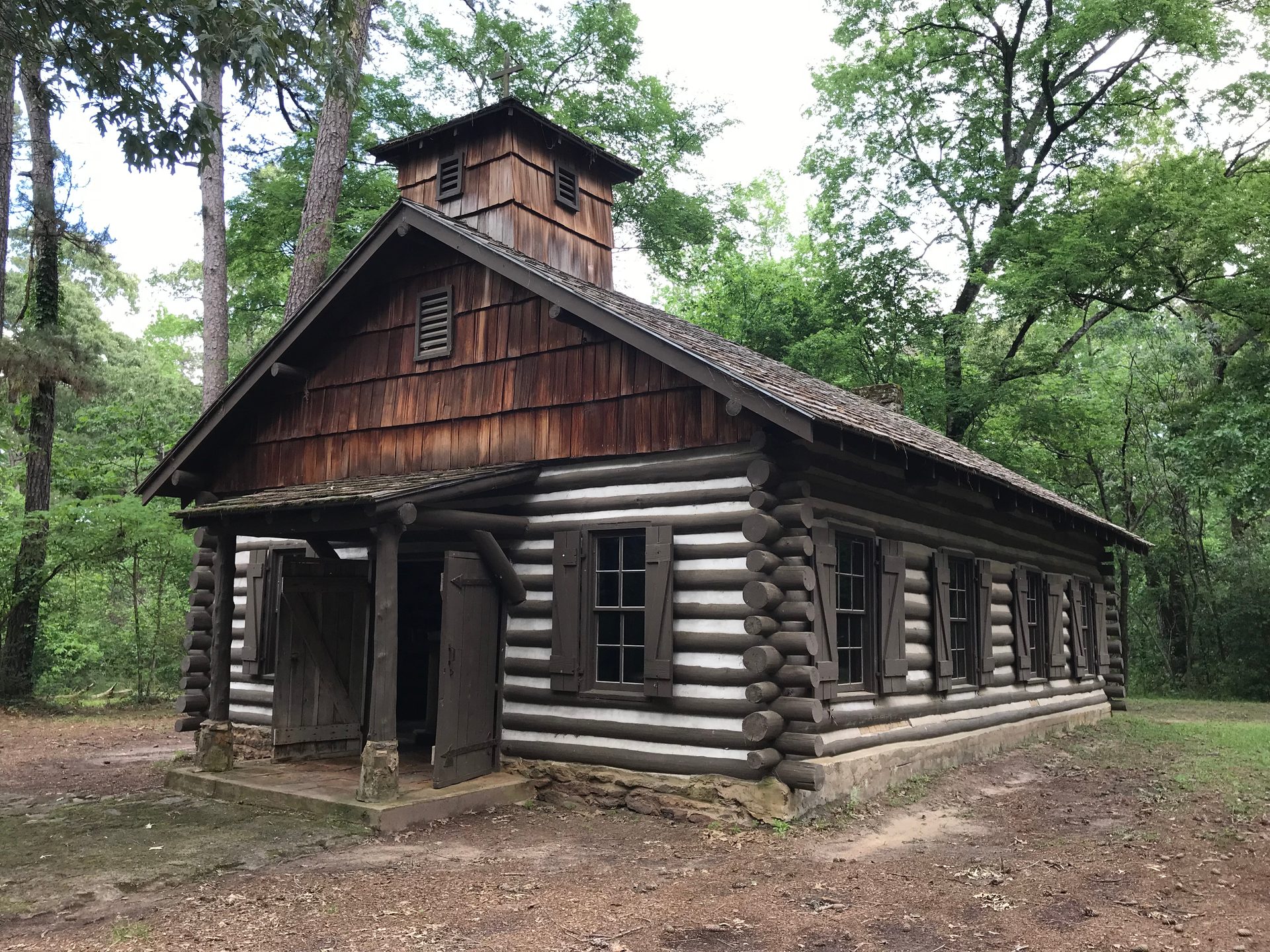
In the ensuing years, the lands around the original mission site were largely unoccupied. In 1934, however, Houston County purchased the land with the intention of creating a historical marker. The site was then chosen to be a project site for the Civilian Conservation Corps (CCC), a Great Depression-era work program that provided conservation and construction jobs to many out-of-work Americans. The 200 men of CCC Company 88 set to work reclaiming this historic land, now known as Mission Tejas State Park. Today, visitors to the park can see a commemorative reconstruction of Mission San Francisco de los Tejas and visit the Rice Family Log Cabin, an 1828 log home built by Anglo-American settlers that was moved into the park in 1973.[6]
Site Information
Location (19343 State Hwy. 21 East, Grapeland, Texas 75844, 16 miles east/northeast of Grapeland, Texas)
Available Facilities
The park offers fishing, picnicking, campsites, and group facilities as well as a commemorative representation of Mission San Francisco de los Tejas.
Exhibits
The park offers pioneer skills demonstrations, as well as school tours of the two historic structures.
El Camino Real de los Tejas National Historic Trail
[1] Juan Bautista Chapa, translated by Ned F. Brierley, "Texas and Northeastern Mexico, 1630-1690", (University of Texas Press: Austin, 1997), 151.
[2] Ibid.
[3] Damián Manzanet and Lilia M. Casis, "Carta de Don Damián Manzanet á Don Carlos de Siguenza Sobre el Descubrimiento de la Bahía del Espíritu Santo / Letter of Don Damián Manzanet to Don Carlos de SiguenzaRelative to the Discovery of the Bay of Espiritu Santo," The Quarterly of the Texas State Historical Association, April 1899, Vol. 2, No. 4 (Apr., 1899), 307.
[4] Ibid., 306-307.
[5] “France and Spain Stake Their Claim,” Mission Tejas State Park Interpretive Guide, 2.
[6] Ibid.
From the National Park Service · nps.gov
Look inside
Getting there
Directions
At El Camino Real de los Tejas National Historic Trail
19343 State Hwy. 21 East, Santa Fe, NM 75844
Go to El Camino Real de los Tejas National Historic Trail.
Get directions