
Cow Creek Crossing/Buffalo Bill’s Well
About
West, and a little south, of the present-day city of Lyons, in Rice County, Kansas the Santa Fe Trail crossed Cow Creek. In 1825 surveyor Joseph C. Brown wrote this description: "Cold Water or Cow creek is a narrow stream, from 30 to 50 links wide, for the most part miry, banks commonly high. There is tolerable crossing just above the largest body of timber on it, which is very conspicuous .... The camping is good on this creek for wood, water, grass and (commonly) buffalo."
Asahel and Abijah Beach were the first to establish a ranch at Cow Creek Crossing in 1858 and applied to build a bridge across Cow Creek. Cow Creek ranch also became "Beach Valley" after a post office was authorized for that place on February 10, 1859. The Beaches built three houses, and a corral. In the winter of 1859-1860 the Beaches finally built their bridge over Cow creek. But Asahel Beach never saw the completed bridge. Asahel Beach fell ill during a trip east and died at Council Grove on February 17, 1860. Late in 1861 or early 1862, Abijah Beach left Cow Creek ranch to marry and settle down at Council Grove as a physician.
William Mathewson became the proprietor of Cow Creek Ranch after the Beaches left. Mathewson was a plainsman and former mountain man. It appears that Mathewson was at the ranch from its beginning days up to 1862. Undoubtedly he was one of the Beaches' "hunters ... who do nothing but kill buffalo". But in 1860, a year of severe drought in Kansas territory, he came to be known as "Buffalo Bill" for his hunting abilities, long before William Cody came along.
Years later in an interview in 1893, William Mathewson was recalled those times in 1860: "There were plenty of buffalo roaming the plains… I took a wagon train and some men and set out for the buffalo grounds, and from September until February we killed buffalo and sent train after train to the famine-stricken people of Western Kansas."
Mathewson is also known for holding off hundreds of Native Americans during a siege of a wagon train and Cow Creek Ranch in July of 1864. One month after the siege, William Mathewson age 34 married Elizabeth Inman, age 22 on August, 26, 1864. It is said that Mathewson did not bring his bride to Cow Creek ranch until she had become expert with rifle and revolver. She was a courageous woman and ran the ranch while Mathewson was away. By February, 1866, William Mathewson was spending most of his time at Fort Zarah. A letter written by "Lizzie" Mathewson, in June 20, 1866, provided the last available information not only of the Mathewson’s residence there, but on the ranch itself.
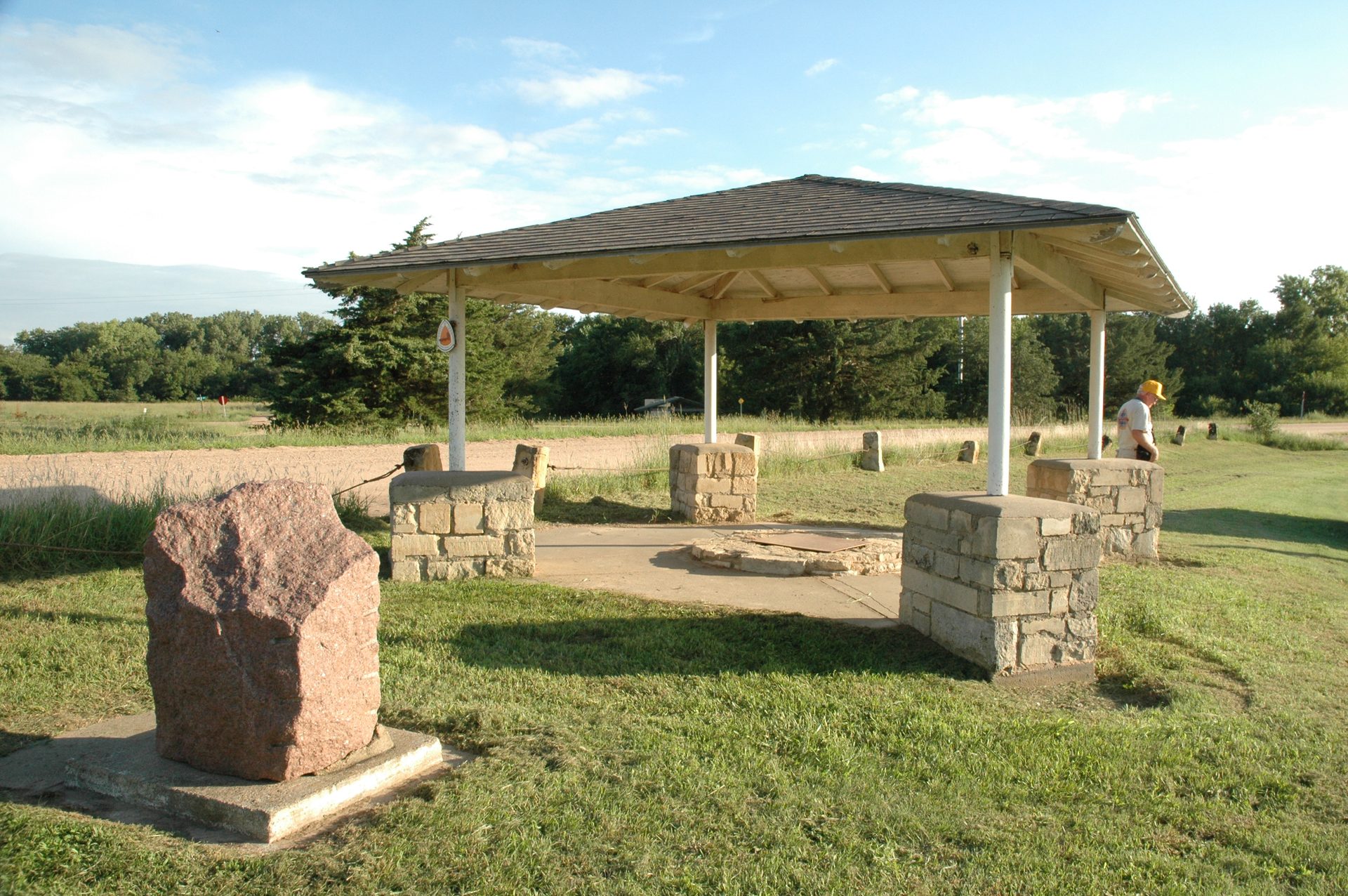
The story of Cow Creek ranch forward from June, 1866, was not recorded and the ranch disappeared from history. However, on the Cow Creek ranch site one artifact remains -- the well. It was described as "about 40 feet deep and walled almost from top to bottom with sandstone slabs which could not have been procured closer than 15 miles away." Very likely it was constructed late in 1858 when the Beaches started their ranch. It became known as "Buffalo Bill's well."
Site Information
Location (Four miles west of Lyons, on U.S. Highway 56 to Father Padilla's Cross, then turn left (south) for one mile on a gravel road. At this point, two gravel roads intersect, and the well is in the northwest quadrant of that intersection, very near the road.)
Available Facilities: This hand dug well can be visited today. The well was nearly wiped out a number of years ago when a road improvement project was under way. It was saved by the timely action of several local historians.
Exhibits: A Daughters of the American Revolution marker is located just north of the well.
From the National Park Service · nps.gov
Look inside
Getting there
Directions
At Santa Fe National Historic Trail
Go to Santa Fe National Historic Trail.
Get directionsFinding it
Four miles west of Lyons, on U.S. Highway 56 to Father Padilla's Cross, then turn left (south) for one mile on a gravel road. At this point, two gravel roads intersect, and the well is in the northwest quadrant of that intersection, very near the road.