
Wayside: Mother Bear is Migrating
Alerts
2 more for Sleeping Bear Dunes National Lakeshore
About
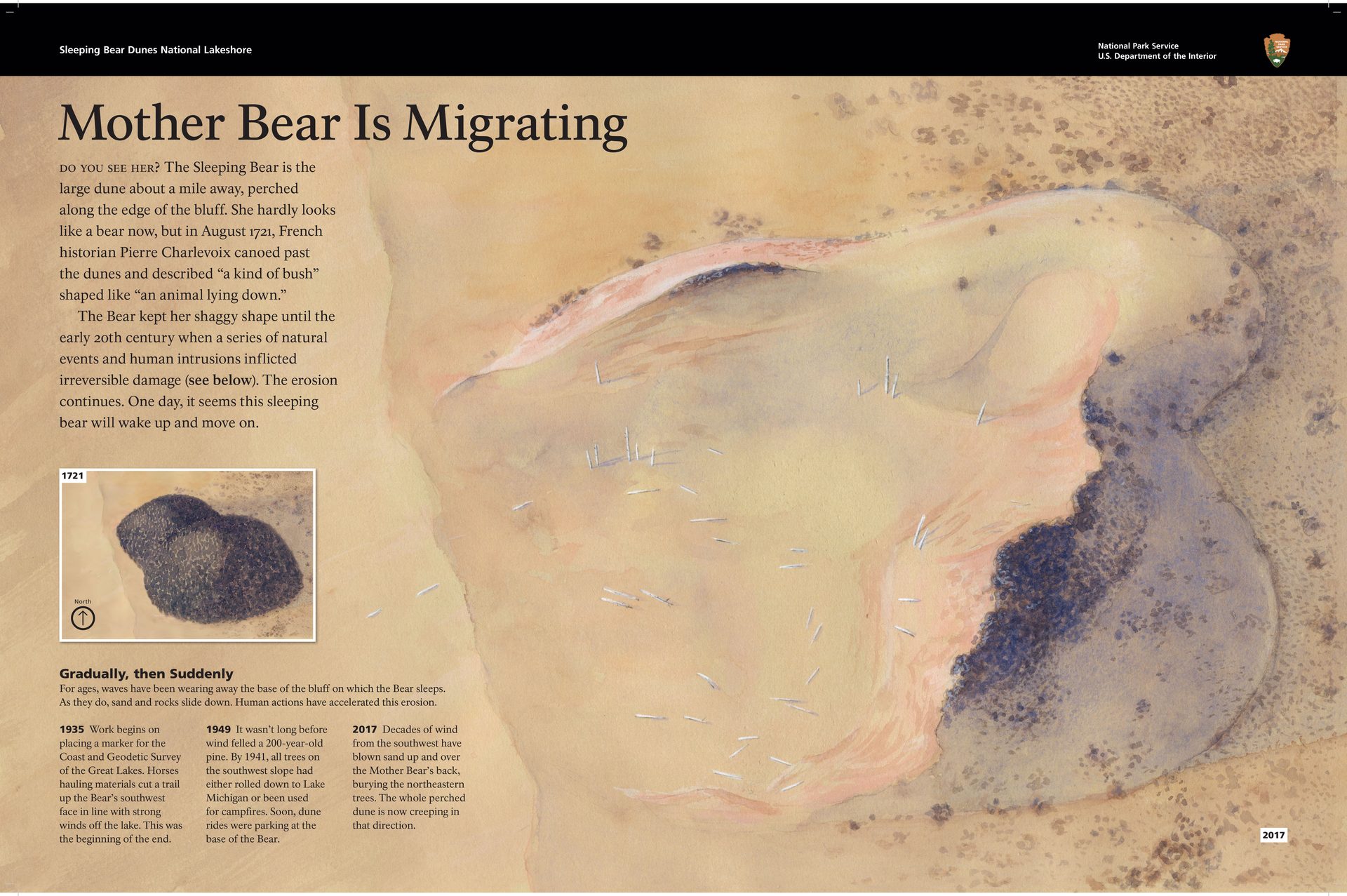
Do you see her? She’s the large dune about a mile (1.6 km) away, perched along the edge of the bluff. She hardly looks like a bear now, but in August 1721, French historian Pierre Charlevoix canoed past the dunes and described "a kind of bush" shaped like "an animal lying down." The bear kept her shaggy shape until the early 20th century when a series of natural events and human intrusions inflicted irreversible damage (see below). The erosion continues. One day, it seems this sleeping bear will wake up and move on.
Gradually, then Suddenly
For ages, waves have been wearing away the base of the bluff on which the bear sleeps. As they do, sand and rocks slide down the slope. Human actions have accelerated this erosion.
1935
Work begins on a station for the Coast and Geodetic Survey of the Great Lakes. Horses hauling materials cut a trail up the bear's southwest face in line with strong winds off the lake. This was the beginning of the end.
1949
It wasn't long before wind felled a 200-year-old pine. By 1941, all trees and snags on the southwest slope had either rolled down to Lake Michigan or been used for campfires. Soon, Dune rides were parking at the base of the Bear.
2015
Decades of wind from the southwest have blown sand up and over the Mother Bear's back, burying the northeastern trees.
From the National Park Service · nps.gov
Look inside
Getting there
Directions
At Sleeping Bear Dunes National Lakeshore
9922 Front Street, Empire, MI 49630
Go to Sleeping Bear Dunes National Lakeshore.
Get directions