Friends Meetinghouse Interior
About
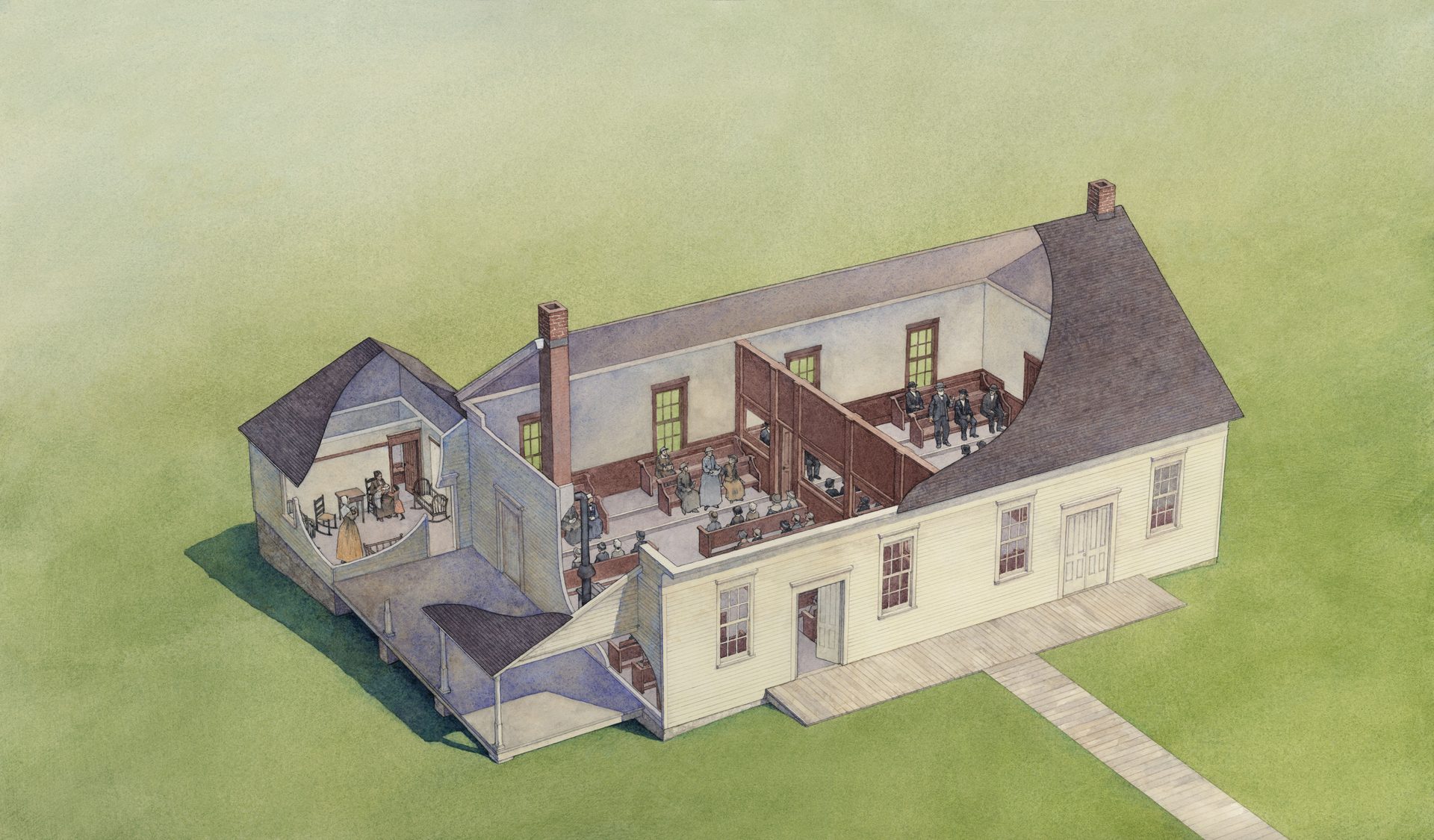
Worshippers sat on benches in “silent waiting” and spoke only when moved by an inner spirit. With the emphasis on individual worship, the meetinghouse had no pulpit or altar, no crucifixes or stained glass, nor an organ or a choir.
Partitions
Males and females sat on each side of an open partition, to encourage individual worship and full participation for women. The partitions were closed during the monthly meetings while membership business—marriages, deaths, births, new members, transfers, and disownment—was discussed. On the coal burning stoves, women heated soap stones which they used to warm their feet in cold weather.
Infants & Children
Infants and young children sat with their mothers. When infants disturbed the silence of the meeting their mothers took them to the nursery, or “cry room,” attached to the women’s side of the Meetinghouse.
Facing Benches
Recorded ministers sat with elders and other respected members on the facing benches in the front of the building. Hulda Hoover, Herbert’s mother, was a recorded minister.
"Strong Training in Patience"
“The long hours of meeting awaiting the spirit to move someone,” Hoover wrote, “may not have been recreation, but it was strong training in patience.” This training put to good use by a man who succeeded in business, fed millions in need, and presided over a nation in the early years of the Great Depression.
From the National Park Service · nps.gov
Look inside
Getting there
Directions
110 Parkside Drive, West Branch, IA 52358
Go to Friends Meetinghouse.
Get directionsContact
Links
Nearby
Other places within a few minutes' walk of Friends Meetinghouse Interior.