Sign-Legacy of an Outdoor Childhood
About
Legacy of an Outdoor Childhood
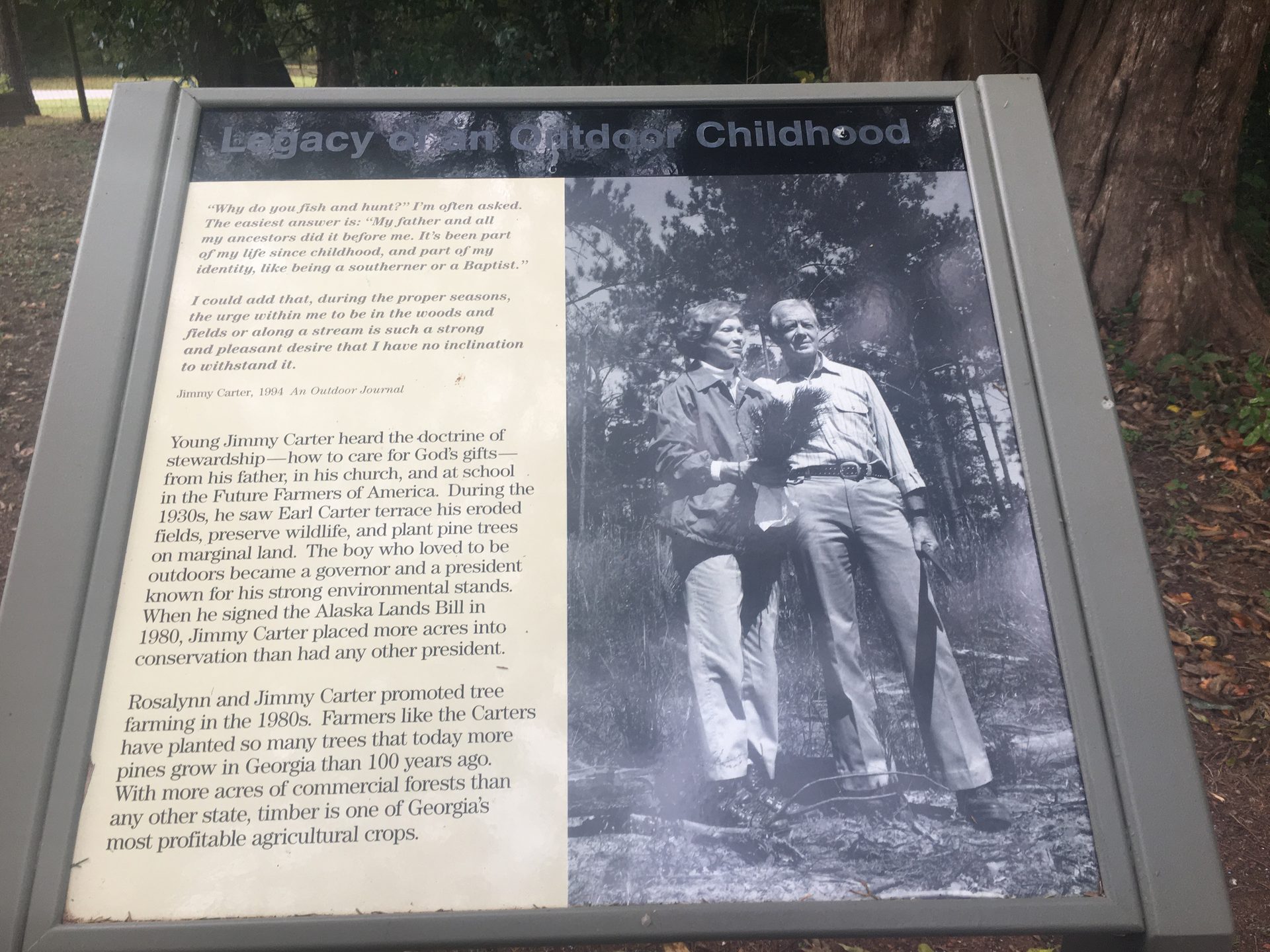
“Why do you fish and hunt?” I’m often asked. The easiest answer is: “My father and all my ancestors did it before me. It’s been part of my life since childhood, and part of my identity, like being a southerner or a Baptist.”I could add that, during the proper seasons, the urge within me to be in the woods and fields or along a stream is such a strong and pleasant desire that I have no inclination to withstand it."
Jimmy Carter 1994, An Outdoor Journal
Young Jimmy Carter heard the doctrine of stewardship – how to care for God’s gifts – from his father, in his church, and at school in the Future Farmers of America. During the 1930s, he saw Earl Carter terrace his eroded fields, preserve wildlife, and plant pine trees on marginal land. The boy who loved to be outdoors became a governor and a president known for his strong environmental stands. When he signed the Alaska Lands Bill in 1980, Jimmy Carter placed more acres into conservation than had any other president.
Rosalynn and Jimmy Carter promoted tree farming in the 1980s. Farmers like the Carters have planted so many trees that today more pines grow in Georgia than 100 years ago. With more acres of commercial forests than any other state, timber is one of Georgia’s most profitable agricultural crops.
Photo: Rosalynn Carter holds a small pine tree as she and Jimmy Carter stand in a field.
From the National Park Service · nps.gov
Look inside
Getting there
Directions
At Jimmy Carter National Historical Park
300 North Bond Street, Plains, GA 31780
Go to Jimmy Carter National Historical Park.
Get directionsContact
Links
Nearby
Other places within a few minutes' walk of Sign-Legacy of an Outdoor Childhood.