
Revealing Layers Wayside
Closed
Thanksgiving Hours. On Wednesday, November 25th, the entire park will close at 2:00pm in observance of the Thanksgiving holiday. The Lower Cliff Dwelling Trail closes to uphill traffic at 1:00pm. The Park will be closed on Thanksgiving Day, Thursday, November 26th. Normal hours will resume on Friday, November 27th at 8:00 am. nps.gov
Alerts
- ClosureThanksgiving HoursOn Wednesday, November 25th, the entire park will close at 2:00pm in observance of the Thanksgiving holiday. The Lower Cliff Dwelling Trail closes to uphill traffic at 1:00pm. The Park will be closed on Thanksgiving Day, Thursday, November 26th. Normal hours will resume on Friday, November 27th at 8:00 am. Posted November 17 · From Tonto National Monument · nps.gov
2 more for Tonto National Monument
About
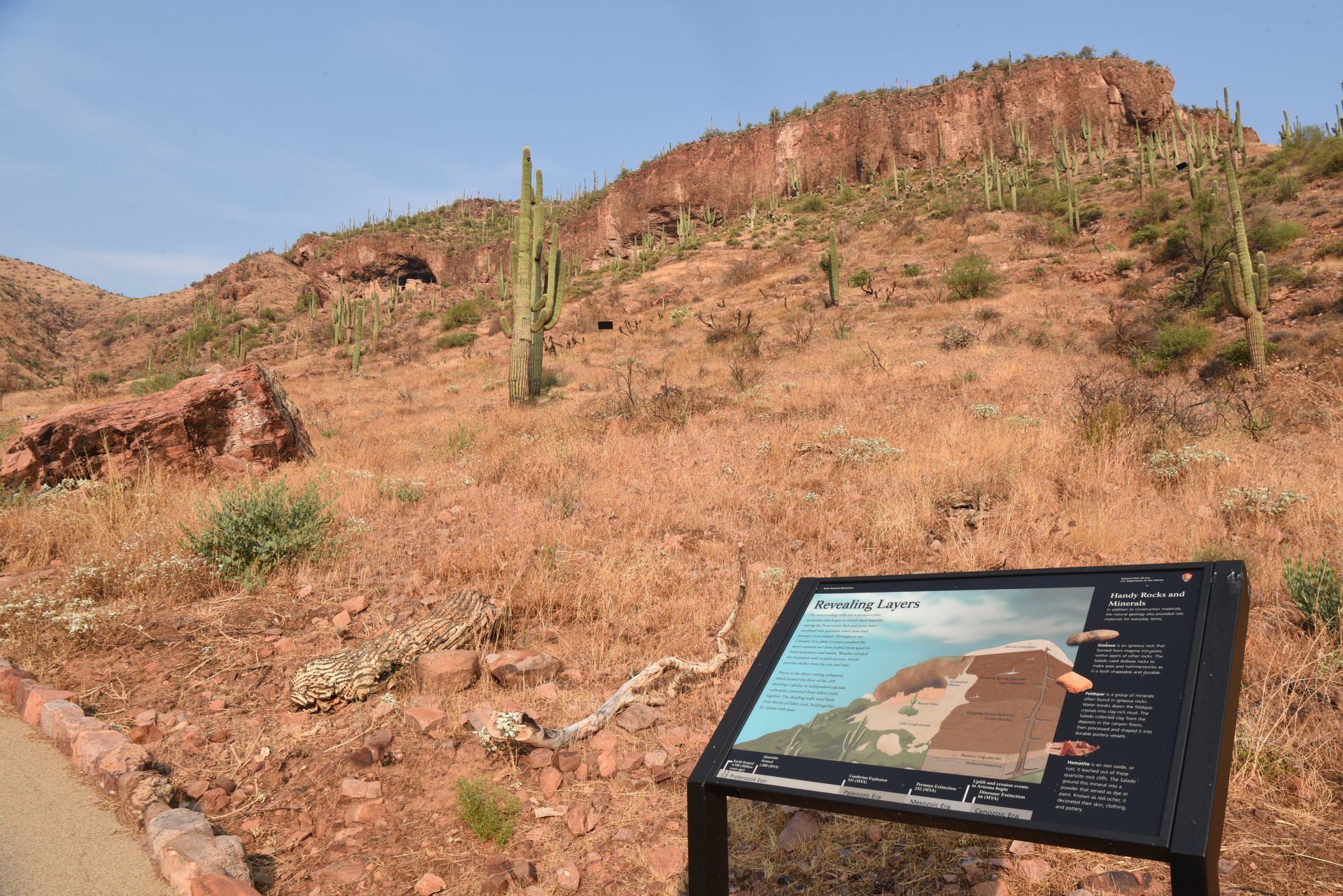
Revealing Layers
The surrounding cliffs are a metamorphic formation that began as beach sand deposits during the Proterozoic Eon and were later morphed into quartzite when heat and pressure were added. Throughout the Cenozoic Era, plate tectonics pushed the layers upward and then pulled them apart to form mountains and basins. Weather eroded the formation and created alcoves, which provide shelter from the sun and rain.
Pieces of the alcove ceiling collapsed, which formed the floor of the cliff dwelling. Caliche, or redeposited calcium carbonate, cemented these fallen rocks together. The dwelling walls were built from blocks of fallen rock, held together by caliche-rich mud.
(Image of hillside depicting soil, rock, and mineral layers. Layers from top to bottom: Mescal Limestone, Dripping Spring Quartzite Upper Member, Dripping Spring Quartzite Lower Member, Barnes Conglomerate, and Pioneer Formation.
A Diabase intrusion runs throughout all layers. On the hillside surrounding image of the cliff dwelling, are the layers from top to bottom: Cemented Plaster, Recent Talus, and Gila Conglomerate.)
(Image of Earth Historical Timeline)
Proterozoic Eon
Earth formed 4,540 (Million years ago).
Quartzite formed 1,000 (MYA).
Paleozoic Era
Cambrian Explosion 541 (MYA).
Mesozoic Era
Permian Extinction 252 (MYA)
Uplift and erosion events in Arizona begin
Cenozoic Era
Dinosaur Extinction 66 (MYA)
Handy Rocks and Minerals
In addition to construction materials, the natural geology also provided raw materials for everyday items.
(Image of Diabase rock.)
Diabase is an igneous rock that formed from magma intrusions within layers of other rocks. The Salado used diabase rocks to make axes and hammerstones as it is both shapeable and durable.
(Image of Feldspar minerals.)
Feldspar is a group of minerals often found in igneous rocks. Water breaks down the feldspar crystals into clay-rich mud. The Salado collected clay from the deposits in the canyon floors, then process and shaped in into durable pottery vessels.
(Image of textile dyed with Hematite iron oxide.)
Hematite is an iron oxide, or rust; it leached out of these quartzite rock cliff. The Salado ground this mineral into a powder that served as dye or paint. Know as red ocher, it decorated their skin, clothing, and pottery.
From the National Park Service · nps.gov
Look inside
Getting there
Directions
26260 N AZ Hwy 188 Lot 2, Roosevelt, AZ 85545
Go to Tonto National Monument.
Get directions